

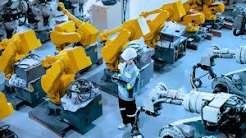
Manufacturers use automation to reduce repetitive work, improve throughput, and make production more consistent. Automated equipment combines robots, controls, sensors, tooling, machine vision, and other production technologies to perform tasks with less manual intervention.
The best systems are not built by selecting a robot or machine first. They start with the production process, including cycle time, part geometry, quality requirements, floor space, safety, and how the new equipment will connect with existing machinery.
What Is Automated Equipment?
Automated equipment is machinery designed to perform production tasks automatically using programmed controls, sensors, robotics, or other electromechanical systems.
A complete automated system may include:
- Industrial robots
- PLCs
- HMIs
- Conveyors
- Servo systems
- Machine vision
- Sensors
- Safety devices
- Custom tooling
- Fixtures
- Data collection systems
GLOBAL Automation Technologies combines these technologies into custom systems built around specific manufacturing requirements.
What Types of Automated Equipment Are Used in Manufacturing?
Automated equipment can support many different production processes.
Machine Tending Equipment
Machine tending systems automatically load and unload equipment such as CNC machines, presses, and molding machines.
A robotic cell can:
- Pick up a raw component.
- Orient it correctly.
- Load it into the machine.
- Start or coordinate the machine cycle.
- Remove the finished component.
- Transfer it to the next operation.
GLOBAL designs automated machine tending cells around cycle time, machine interfaces, part presentation, and unattended production requirements.
Material Handling Equipment
Material handling automation moves parts between machines, conveyors, racks, pallets, and production stations.
Applications can include:
- Pick-and-place
- Palletizing
- Depalletizing
- Bin picking
- Racking
- Conveyor transfer
- Part positioning
Integrated controls help keep these movements synchronized with the rest of the production line.
Automated Assembly Equipment
Assembly automation combines several operations into a controlled sequence.
A system may perform:
- Component insertion
- Fastening
- Pressing
- Dispensing
- Part handling
- Inspection
- Functional testing
GLOBAL integrates robots, tooling, fixtures, controls, and inspection technology into assembly cells designed around the specific product and manufacturing process.
How PLC Controls Support Automated Equipment
The PLC often acts as the central controller of an automated machine.
It receives information from sensors and sends commands to equipment such as:
- Robots
- Motors
- Conveyors
- Pneumatic devices
- Safety systems
- Machine tools
The HMI provides operators with a visual interface for monitoring production, adjusting approved settings, viewing alarms, and troubleshooting faults.
GLOBAL provides PLC and HMI programming alongside electrical design, robot integration, safety controls, and commissioning.
How Machine Vision Makes Automated Equipment More Flexible
Automation works most easily when every component arrives in exactly the same location and orientation.
Real production environments are often less predictable.
Machine vision can help identify:
- Part position
- Orientation
- Presence
- Defects
- Labels
- Dimensions
- Assembly completeness
The information can then guide a robot or determine whether a part should continue through production.
GLOBAL integrates machine vision with robotics and controls for part location, tracking, quality verification, and more adaptive production workflows.
Automated Equipment for Inspection and Quality Control
Automation is not limited to moving or assembling products.
Inspection systems can verify whether a component meets defined requirements before it moves to the next process.
Depending on the application, automated inspection can check:
- Part presence
- Orientation
- Surface features
- Assembly completeness
- Dimensions
- Labels or codes
Integrating inspection directly into the production system can reduce the delay between producing a defect and identifying it.
What Are the Benefits of Automated Equipment?
Higher Throughput
Automated equipment can perform repetitive operations at consistent cycle times.
This can help manufacturers increase output without adding an equivalent amount of manual labor.
Better Repeatability
A programmed system performs the same sequence according to defined parameters.
That consistency can be particularly useful for assembly, material handling, dispensing, and inspection.
Improved Safety
Automation can reduce employee exposure to repetitive lifting, hazardous environments, hot components, sharp materials, or other demanding tasks.
Better Equipment Utilization
Machine tending and coordinated automation can keep production equipment running for longer periods with fewer interruptions.
GLOBAL designs systems around throughput, safety, quality, and equipment utilization rather than automation for its own sake.
Automated Equipment vs. Standalone Machinery
A standalone machine performs a defined task.
An integrated automated system coordinates several pieces of equipment as one production process.
For example, a manufacturing cell might connect:
CNC Machine → Robot → Vision Inspection → Conveyor → Assembly Station
The PLC exchanges signals between each component so the entire process operates in the correct sequence.
This integration is often where an automation project becomes more complex than simply purchasing individual machines.
Can Existing Equipment Be Automated?
Yes. Manufacturers do not always need to replace an entire production line to introduce automation.
Existing machinery may be upgraded through:
- Robot retrofits
- New PLC controls
- Machine vision
- Conveyor integration
- Sensors
- Safety upgrades
- Updated HMIs
GLOBAL supports automation retrofits and line upgrades for manufacturers that want to modernize existing equipment or increase capacity without rebuilding the entire process.
When Does Custom Automated Equipment Make Sense?
Custom automation is worth evaluating when a process has:
- High production volume
- Repetitive manual tasks
- Labor availability challenges
- Quality inconsistencies
- Ergonomic concerns
- Production bottlenecks
- High machine idle time
- Complex equipment handoffs
The first step should be understanding the current process and identifying the actual constraint.
A system integrator can then determine whether robotics, controls, tooling, vision, or another automation technology provides the most practical solution.
How Is Automated Equipment Designed?
A turnkey automation project usually moves through several stages.
1. Process and Feasibility Study
Engineers review the parts, process, cycle time, floor space, production volume, and safety requirements.
2. Simulation and Concept Development
Robot reach, motion, tooling, and cycle time can be modeled before equipment is built.
GLOBAL uses AI-assisted simulation to help identify potential problems earlier and accelerate robot programming.
3. Mechanical and Controls Engineering
The system is designed around robots, fixtures, tooling, electrical controls, and safety equipment.
4. Build and Testing
Equipment is assembled and tested before shipment.
Factory acceptance testing can verify robot reach, tooling performance, controls, and cycle time before installation.
5. Installation and Commissioning
The automation system is installed and connected to the manufacturer’s production environment.
6. Training and Support
Operators and maintenance teams receive documentation and training for the new equipment.
What Should an Automated Equipment Integrator Provide?
A strong integrator should be able to coordinate the entire project rather than leaving the manufacturer to manage several separate vendors.
Look for capabilities including:
- Process engineering
- Simulation
- Robotic integration
- Mechanical design
- Controls engineering
- Machine vision
- Custom tooling
- Safety systems
- Installation
- Commissioning
- Training
- Long-term support
GLOBAL combines these services with technical staffing, allowing manufacturers to access both automated systems and the engineering talent required to operate and improve them.
Build Automated Equipment Around Your Production Goals
The right automation system starts with the process, not the hardware. Cycle time, parts, equipment interfaces, quality requirements, labor constraints, and floor space should determine how the system is designed.
GLOBAL Automation Technologies designs and integrates automated equipment for machine tending, material handling, assembly, inspection, packaging, finishing, and other manufacturing applications. Their team can take a project from feasibility and simulation through build, installation, commissioning, and production support.
