

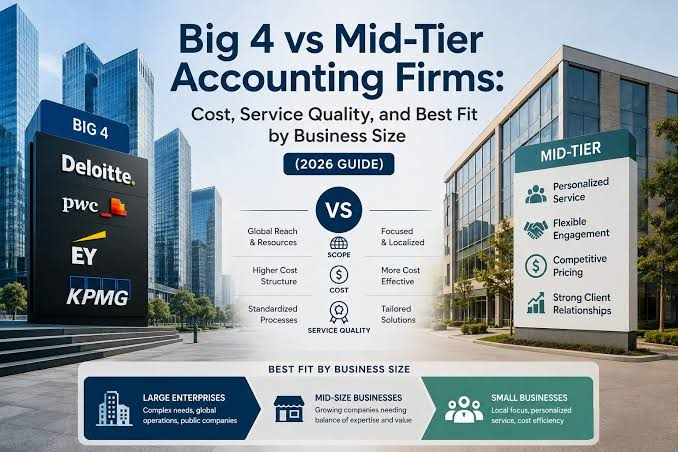
Choosing an accounting firm is not simply a procurement decision. It shapes how your business manages compliance, structures its finances, responds to regulatory scrutiny, and prepares for growth or transition. Yet many businesses approach this choice with less rigor than they would apply to hiring a senior employee or selecting a core technology vendor.
The accounting industry is not uniform. Firms differ significantly in size, specialization, client profile, and the way they deliver work. A large multinational audit firm operates nothing like a regional accounting practice, and neither operates like a niche advisory boutique. Each has genuine strengths and real limitations. Understanding those differences in practical terms — not just by reputation or brand recognition — is what allows a business to make a decision that actually holds up over time.
This article walks through the three primary categories of accounting firms, what each one genuinely offers, where each one tends to fall short, and how to match the right type of firm to the specific profile and priorities of your business.
Understanding the Three Tiers of Accounting Firms
The accounting profession organizes itself into recognizable tiers, and those tiers exist for practical reasons. When businesses and financial analysts refer to top accounting firms, they are usually drawing on a framework that distinguishes firms by global reach, service breadth, staffing depth, and the complexity of clients they typically serve. A reliable reference point for understanding how firms are ranked and compared — particularly in markets like India — can be found in resources such as this overview of top accounting firms, which outlines how firms are structured across the professional spectrum.
The three primary categories — Big 4, mid-tier, and boutique — are not arbitrary labels. They reflect real differences in how firms are organized, how they price their services, what industries they prioritize, and what level of client engagement a business can realistically expect. Understanding each category on its own terms is a more useful starting point than relying on general reputation alone.
Big 4 Firms: What They Are and How They Actually Operate
The Big 4 — Deloitte, PwC, EY, and KPMG — are global professional services organizations with offices in dozens of countries and tens of thousands of professional staff. They handle statutory audits for publicly listed companies, cross-border tax structures, large-scale advisory mandates, and regulatory compliance for entities operating across multiple jurisdictions.
Their scale is both their defining strength and their most significant constraint. Because they serve large, complex clients, their internal systems, documentation standards, and engagement processes are built around that complexity. A mid-sized private company that engages a Big 4 firm often finds that the work is handled by junior staff and reviewed — sometimes briefly — by a senior manager. The partner who pitched the engagement may be largely absent from the actual delivery.
This is not a failure of the firm. It is simply how firms of that size operate. The model is built for volume and risk management at scale, not for close advisory relationships with smaller clients. For businesses that require a recognized audit signature on financial statements for regulatory or investor purposes, or that operate in multiple countries and need coordinated filing across jurisdictions, the Big 4 structure makes sense. For businesses that need responsiveness, continuity, and depth of attention from senior practitioners, the structure often works against them.
Mid-Tier Firms: The Practical Middle Ground
Mid-tier accounting firms — which include regional networks, national practices, and internationally affiliated firms outside the Big 4 — occupy a position that is frequently underestimated. These firms typically serve established private businesses, family-owned enterprises, growing companies preparing for institutional investment, and entities in regulated industries that require credible professional oversight without the cost or operational overhead of a Big 4 engagement.
What mid-tier firms offer that larger firms often do not is a combination of service breadth and genuine partner-level involvement. In a well-run mid-tier firm, the partner assigned to an engagement is actively involved in the work, knows the client’s situation in detail, and is accessible when questions arise. This continuity matters considerably in areas like tax planning, where decisions made in one year have consequences in the next, and where the advisor’s familiarity with the client’s history is directly relevant to the quality of advice.
Mid-tier firms are also better positioned to grow with a client. A business that is currently private but planning a future capital raise or acquisition will benefit from working with a firm that understands where the business is going, not just where it currently sits. Many mid-tier firms have built structured practices around transaction advisory, due diligence, and regulatory compliance specifically because their client base moves through those transitions.
Boutique Accounting and Advisory Firms: Depth Over Breadth
Boutique firms are specialized practices, often small in headcount, that focus on a specific service line, industry sector, or type of client. Examples include firms that work exclusively with technology startups, firms that specialize in estate and succession planning for high-net-worth families, firms that focus on government contracting compliance, or practices that handle only forensic accounting and dispute support work.
The appeal of a boutique firm is straightforward: when a business has a specific, well-defined need, a firm that has built its entire practice around that need will typically outperform a generalist firm working in the same area. A boutique forensic accounting firm, for example, will have more refined methodologies, more relevant case experience, and more specialized staff than a large generalist firm offering forensic services as one of twenty practice areas.
Where Boutique Firms Have Real Limitations
Boutique practices are not designed to serve as a business’s primary accounting relationship unless the business itself is narrowly focused. A growing company needs ongoing tax compliance, payroll accounting, financial statement preparation, regulatory filings, and periodic advisory work. A boutique firm focused on a single specialty cannot provide that breadth without either expanding beyond its expertise or referring the client elsewhere repeatedly.
There is also a continuity risk with very small practices. If a boutique firm is built around one or two senior practitioners and one of them exits, retires, or becomes unavailable, the client relationship can be disrupted in ways that are difficult to manage at a critical moment. This risk is worth assessing carefully, particularly for clients who rely on the firm for time-sensitive compliance work.
Boutique firms are most effective when used in combination with a primary accounting relationship — engaged for a specific project, transaction, or advisory challenge where their specialized knowledge adds measurable value that a generalist firm cannot match.
Matching Firm Type to Business Profile
The practical question is not which type of firm is best in general, but which type is most appropriate for a given business at a given stage. That determination depends on a set of factors that are specific to the business, not to the firm’s reputation or size.
Company Size and Structural Complexity
A business with a single operating entity, a domestic customer base, and straightforward revenue recognition does not need the infrastructure of a Big 4 firm. The overhead built into Big 4 engagements — in terms of documentation, review layers, and internal compliance requirements — adds cost without adding proportional value for a client of that profile. A well-staffed mid-tier firm or even a larger regional practice will deliver technically sound work at a fraction of the cost, with better senior-level engagement.
Conversely, a company that operates across multiple countries, maintains complex intercompany transactions, is subject to public reporting requirements, or is preparing for a public offering genuinely needs the capabilities that only a large firm can provide. The International Federation of Accountants maintains global standards that govern audit and assurance engagements, and compliance with those standards at scale requires the systems and staffing depth that large firms have built specifically for that purpose.
Growth Stage and Future Transactions
A business in an early growth stage has different accounting needs than one that is preparing for a merger, acquisition, or external capital raise. Early-stage businesses typically need clean bookkeeping, accurate tax filings, and periodic advisory input on structuring decisions. A mid-tier or capable regional firm is usually sufficient for this.
As the business moves toward a transaction or institutional investment, the requirements shift. Investors and acquirers frequently require audited financial statements from recognized firms. In some cases, they will specify a preference for Big 4 or upper mid-tier firms. A business that has built its accounting relationship with a smaller firm may need to transition — and that transition takes time. Planning for it in advance, rather than reacting to investor requirements at a critical moment, is a practical reason to think ahead about firm selection.
Industry-Specific Regulatory Requirements
Certain industries carry regulatory requirements that effectively narrow the field of qualifying firms. Financial services, healthcare, government contracting, and publicly listed entities all operate under sector-specific compliance regimes that require auditors and advisors with direct, documented experience in those areas. A firm without that experience is not simply a weaker option — it may be a non-qualifying one.
Businesses in regulated industries should evaluate firm selection not only on general competence but on demonstrated experience with the specific regulatory framework that governs them. This means asking detailed questions about relevant engagements, not accepting general claims about industry coverage.
The Selection Process: What Actually Matters
Choosing between firm types is only part of the decision. Within any category, there is significant variation in quality, culture, and fit. A mid-tier firm with a strong track record in a relevant industry and a stable partner team may outperform a Big 4 firm in which the client receives inconsistent attention. The category provides a starting framework, but the selection process requires a closer look.
• Understand who will actually do the work and who will review it — not just who will represent the firm in initial conversations.
• Ask specifically about experience with businesses of comparable size, structure, and industry, and request verifiable examples where appropriate.
• Assess how the firm communicates during an engagement, not just during the sales process — response time, clarity, and proactivity are operational factors, not soft ones.
• Consider whether the firm’s current client base is compatible with your own trajectory — a firm that primarily serves very small businesses may not scale well with a company that is growing rapidly.
• Evaluate fee structures in relation to the value and depth of service delivered, not simply by comparing headline rates between firms of different sizes.
Conclusion: Fit Matters More Than Reputation
The most recognizable accounting firms are not automatically the most appropriate ones for every business. The Big 4 provide genuine value for clients whose complexity and regulatory requirements justify their cost and structure. Mid-tier firms offer a combination of technical competence and senior engagement that serves a wide range of established businesses well. Boutique firms deliver concentrated expertise in specific areas that generalist practices cannot match.
What determines the right choice is not which firm has the strongest brand, but which firm’s structure, experience, and way of working aligns with what your business actually needs — today and over the next several years. That assessment requires honest clarity about your business’s size, complexity, regulatory obligations, and growth plans.
Businesses that make this choice carefully, and revisit it as their circumstances change, tend to build accounting relationships that hold up under pressure. Those that choose by reputation alone often find themselves either overserved and overpaying or underserved at moments when the quality of professional advice matters most.
