

Every Family aspires to have financial security. As we work hard for our families, we want our loved Ones to be safe, secure and comfortable against any possible mishaps that may arise in future. Every Indian family’s first step towards financial security is to buy a life insurance policy.
However, when we start evaluating options, it becomes overwhelming as to what exactly do we need!
The two most prominent options are term insurance and traditional life insurance plans. Both have their unique methods of securing the financial future of the family.
The insurance debate: Life insurance vs term insurance
is extremely important to understand to make an informed decision for your family. Let’s understand the nuances of each in detail.
Understanding the basics – what is life insurance?
Life insurance is a very basic contract between you and the insurance company. You pay a certain premium to the company, and in return, they pay a certain sum of money to the family in case of your unfortunate demise while the policy is active.
“Life insurance” is a generic term that covers all types of insurance policies. However, most people tend to consider traditional investment-based policies as life insurance. These include endowment plans, whole life, money back plans, ULIPs, etc.
Some features of traditional life insurance plans:
- Both investment and protection: They provide dual benefits of protection as well as regular savings or investment.
- Maturity benefit: In case you survive the policy term, you are entitled to receive a certain amount (depending on the plan) as maturity proceeds.
- Higher premium: Since they combine the benefit of regular savings/investment along with a cover of life insurance, the premium is a little higher.
- Structured savings: This is an ideal option for families who want to make sure they have regular savings every month for a certain time interval for securing future goals like a child’s marriage or education.
If you are a person who finds it difficult to save money on a monthly basis but would love to have some assured amount for your future or that of your child, this is probably the best option for you.
What is a term insurance?
Now, let’s look at term insurance. Term insurance is the simplest and purest form of life insurance. When you buy a term insurance policy, you pay a small, regular premium to secure a very large life cover for a specific duration say 20, 30, or 40 years.
Some key features of term insurance plans:
- Pure risk coverage: Your entire premium goes into the life coverage. There is no investment or maturity benefit involved.
- Low premium for high coverage: Compared to traditional life insurance plans, the premium is comparatively lower for a really high sum assured. For a really young and healthy individual, the premium for a ₹1Crore Sum Assured would be really affordable.
- Family protection: In case of your demise, the family will get the sum assured for their support. The sum assured will be directly paid to the nominee.
- No survival benefit (in standard plans): Unlike traditional life insurance plans, if you survive the term of the policy, you wouldn’t get any money back (in case of standard term plans). However, there is an option of ‘return of premium’ wherein the nominee will get back all the paid premiums (along with the sum assured in case of death during the policy term), but on a higher premium basis.
Term insurance plans help us answer one big question – in case of the breadwinner’s demise, how will the family pay off the pending loans, clear all dues and still manage to run their daily expenses as well as fulfill long-term financial goals?
Eligibility for tax benefits on Insurance Premiums as per the New Income Tax Act 2025
Tax benefits play a significant role when it comes to buying life insurance. In the New Income Tax Act 2025, there are a few sections to consider:
- Section 123 (deduction on premium paid): You will be able to claim deduction on the insurance premium paid (to the extent of ₹1.5 Lakh) under this section. (Note: The deduction on premium under section 123 is applicable only under the Old Tax Regime. If you have opted for the New Tax Regime under Section 202, these premium deductions are not applicable.)
- Section 126 (riders & health add-ons): If you want to add health add-ons to your life insurance policy (Critical Illness riders, Surgical care riders), you will be able to claim additional deductions under section 126 for the premium paid for the same. The amount of deduction allowed under this section is up to ₹25,000 for yourself, your spouse or your children and up to ₹50,000 for senior citizen parents.
- Section 11 read with Schedule II (tax-free payout): The nominee (person who gets the claim amount) will get the sum assured or maturity benefit absolutely tax-free. However, in case of maturity proceeds (in case of an endowment or a ULIP plan), the tax exemption will be available for the maturity proceeds if the annual premium limit (like ₹2.5 Lakh for ULIPs and ₹5 Lakh for non-ULIP policies issued on or after April 1, 2023) and the 10% sum-assured condition are met.
However, if these limits are exceeded, the maturity proceeds may become taxable under capital gains or applicable tax slabs. For better understanding, you can use a life insurance calculator.
How should an Indian family decide which is their primary protection?
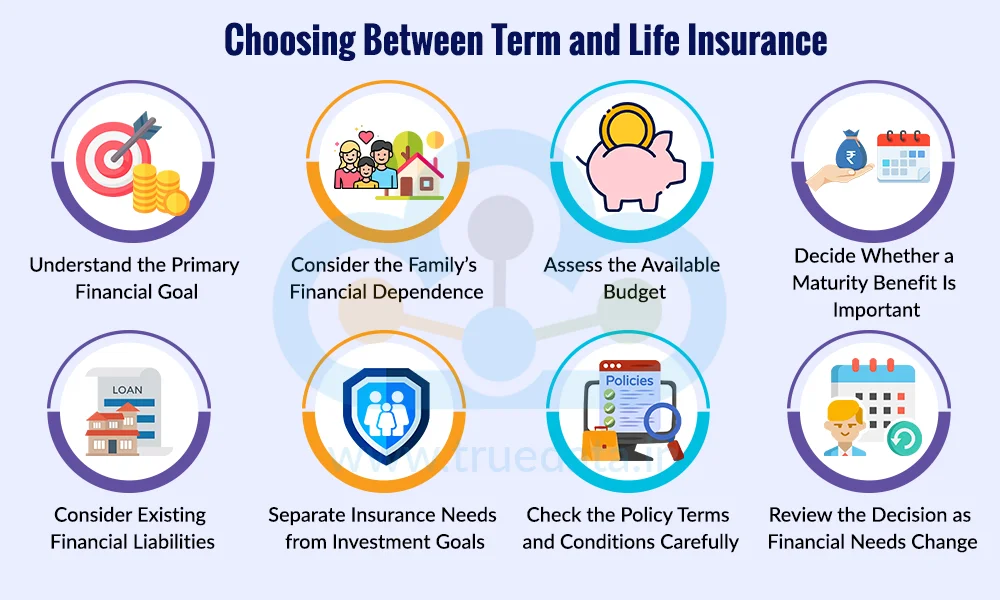
Every family is different. Depending on financial goals, dependents, monthly expenses, debts, etc., every individual has their own perspective. Here is a basic roadmap that could enable people to make an informed decision:
Step 1: Prioritize pure protection first
For almost every working individual or breadwinner, term insurance should be their first priority.
If you have a home loan, personal loan, senior parents or children, in case of your unexpected demise, you expect your family to survive without any financial distress. However, traditional life insurance plans require a really high premium to get a good sum assured. However, with term insurance plans, you can get a really high sum assured (10-15X your income) that could pay off your existing debts in case of any mishap. It is important to secure your family against such financial distress, and term insurance helps do that at an affordable premium.
Step 2: Consider traditional life insurance for goals
Now that you have pure protection (through term insurance), it’s time to think of your financial goals. The following applies to you if:
- You want assured returns with disciplined, low-risk, long-term savings
- You want hassle-free systematic investment to achieve your long-term financial goals
- You wish to invest surplus money (after taking care of your primary insurance and building a corpus for emergencies)
Step 3: Check essential conditions
While purchasing any insurance policy, always consider the following:
- Truthful information: Always disclose health, occupation, and any ailment (if any). The claim may be rejected if any false information is disclosed.
- Different premiums: Premiums vary depending on the age and health of the proposer.
- Add-ons: You might want to consider add-ons like Accidental Death Benefit to get additional cover.
- Claim Settlement Ratio (CSR): Check online for the claims settlement ratio of the insurance company and read all the fine print before buying the policy.
Conclusion
In the life insurance vs term insurance debate, it is important to understand that it may not be an either-or situation. However, it is extremely important to understand the sequence. Buy a term insurance plan when you are young and healthy to protect your family from financial distress. After that, as per your financial needs, go ahead and build your long-term wealth through traditional life insurance or other investment avenues. Today’s small step will secure your family’s future for all time to come.
