

Healthcare facilities operate under a level of scrutiny that most other environments never encounter. Every corridor, ward entrance, medication room, and restricted zone carries real responsibility — and the systems used to monitor these spaces must perform accordingly. When a camera fails to capture a clear image at the moment it matters most, the consequences extend beyond a security gap. They can affect patient safety investigations, staff accountability reviews, and compliance audits that carry legal weight.
The choice between IP-based and analog surveillance systems is not simply a technical preference. It reflects how a facility approaches operational risk, infrastructure planning, and long-term reliability. As hospitals expand, renovate, and integrate more connected systems, the surveillance infrastructure they choose now will shape what is possible — or impossible — years from now. This comparison examines how each system performs in the specific demands of a clinical environment, not in ideal conditions, but in the day-to-day realities of hospital operations.
What a Hospital Camera System Is Actually Required to Do
A hospital camera system is not a standard commercial security installation. It operates in an environment with unique pressures: continuous 24-hour operation, strict patient privacy regulations, frequent staff movement across multiple zones, and the need to document events with enough clarity to support clinical or legal review. These requirements make the performance baseline for hospital surveillance considerably higher than in most other settings.
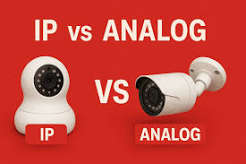
Analog and IP cameras both capture video, but they handle these demands very differently. Analog systems transmit a continuous video signal over coaxial cable to a centralized recording unit. IP cameras convert video into digital data, transmit it over a network, and often include onboard processing that enables features like motion detection, remote access, and integration with other building systems. The distinction matters because hospital environments require surveillance to do more than simply record — they need it to be retrievable, scalable, and consistently reliable across complex physical spaces.
Privacy, Access Control, and Regulatory Compliance
Hospitals must balance surveillance coverage with patient privacy protections. Regulations governing patient data and dignity — including those outlined under frameworks like HIPAA in the United States — impose strict requirements on how facilities manage recorded footage, who can access it, and how long it is retained. An analog system with a single centralized recording unit may create challenges in meeting these requirements because access controls are often limited and footage retrieval is manual and time-consuming.
IP-based systems can be configured with user-level access permissions, encrypted data transmission, and automated retention scheduling. This means different staff roles can be granted appropriate access without providing broad visibility into the entire camera network. In a regulatory review or incident investigation, the ability to retrieve specific footage quickly and demonstrate controlled access is not a minor convenience — it is a compliance requirement that carries real consequences if mishandled.
Image Quality and Incident Documentation
The practical value of any surveillance system in a hospital is most clearly tested when something goes wrong. Whether it is a medication administration dispute, a patient fall, an unauthorized access event, or a staff safety concern, the footage captured at that moment needs to be clear enough to be useful. Grainy, low-resolution images may confirm that something occurred but rarely provide the detail needed for a meaningful investigation.
Analog cameras are constrained by the resolution limits of the coaxial transmission format. The image quality they produce was considered acceptable in environments where surveillance was primarily deterrent-based. In hospitals, where footage may be reviewed frame by frame during incident analysis, that limitation becomes a practical problem. IP cameras operate at significantly higher resolutions, which means that wide-area views of corridors or nursing stations can still yield recognizable detail when zoomed in during review.
Low-Light Performance in Clinical Environments
Many hospital spaces are not brightly lit throughout the night. Patient rooms, recovery wards, and hallways operate under reduced lighting during overnight hours to support patient rest. This creates a recurring low-light challenge that surveillance systems must handle without sacrificing image quality.
Modern IP cameras are commonly equipped with sensors designed for low-light environments, producing usable footage even in conditions where analog cameras would return dark or indistinct images. This is not a minor technical distinction. In a patient room where a fall or medical event occurs overnight, the quality of that footage can directly affect whether staff actions are clearly documented or remain ambiguous. The reliability of low-light performance in IP systems makes them a more consistent tool for around-the-clock clinical documentation.
Scalability and Infrastructure Demands
Hospitals are rarely static environments. Wings are added, departments are relocated, and patient capacity shifts over time. A surveillance system that cannot grow alongside the facility without major infrastructure replacement becomes a recurring capital expense rather than a long-term asset. This scalability consideration is one of the most significant practical differences between analog and IP-based systems.
Analog installations require dedicated coaxial cabling runs from each camera back to a central recording unit. Every new camera location means a new cable run and potential modifications to the recording hardware. As a hospital grows, this architecture can become difficult to manage and expensive to extend. IP cameras use existing network infrastructure — the same cabling that supports computers, access control systems, and communication devices. Adding a new camera often means connecting to an existing network point rather than running new cable across the facility.
Remote Access and Centralized Management
Larger hospital campuses often include multiple buildings, satellite clinics, or off-site facilities that fall under the same security and administrative oversight. Analog systems are inherently localized — the footage is stored at the recording unit, and monitoring requires physical presence or a separate connection for each location. This architecture does not support the kind of centralized oversight that multi-site healthcare operations increasingly depend on.
IP-based systems can be managed across locations from a single interface, with footage accessible to authorized personnel regardless of which building or campus the camera is installed in. Security directors, facility managers, and compliance officers can review footage, check camera status, and respond to alerts without needing to be physically present at each site. In a healthcare group with multiple locations, this operational advantage is substantial and directly affects how quickly incidents can be reviewed and addressed.
Reliability, Maintenance, and Long-Term Costs
The cost of a surveillance system is not limited to the purchase price. It includes maintenance demands, hardware replacement cycles, support requirements, and the operational cost of system failures. In a hospital environment, a camera that goes offline undetected in a restricted area is not simply a technical fault — it is a security gap that may go unnoticed until after an incident has occurred.
Analog systems generally have fewer network dependencies, which can make them simpler to troubleshoot in isolation. However, they offer limited self-monitoring capability. A failed camera on an analog system is often discovered only when someone reviews footage and finds it missing. IP cameras can be configured to send automated alerts when a unit goes offline, loses network connection, or experiences a hardware fault. This means maintenance teams can address problems proactively rather than reactively.
Hardware Lifespan and Future Compatibility
Analog recording technology has been largely static for some time. The systems in use today are not fundamentally different from those installed a decade ago, and the ecosystem of compatible equipment continues to narrow as manufacturers shift resources toward IP-based products. Hospitals that invest in analog infrastructure now are choosing a technology path with limited forward compatibility and a shrinking support base.
IP camera technology continues to develop, and the network infrastructure it relies on — standard ethernet cabling and switching equipment — is maintained independently across the broader technology industry. This means that IP-based hospital surveillance systems can evolve incrementally as new camera hardware becomes available, without requiring wholesale replacement of cabling or core infrastructure. From a capital planning perspective, that compatibility matters over a ten- or fifteen-year operational horizon.
Integration with Broader Hospital Security Systems
Modern hospital security does not operate in isolation. Access control systems, nurse call systems, visitor management platforms, and emergency response protocols all function more effectively when they share information rather than operate independently. Surveillance is one component in a larger operational framework, and how well a camera system integrates with adjacent technologies affects the overall performance of hospital security.
IP-based systems are designed to communicate over standard network protocols, which makes integration with other networked systems significantly more practical. A door access event can automatically trigger a review of camera footage from that location. A motion alert from a restricted area can generate a notification in a security management platform. These connections reduce the manual coordination burden on security staff and create a more responsive overall system. Analog cameras, as standalone hardware, require additional bridging technology to achieve even basic integration with networked systems, adding cost and complexity without fully closing the gap.
Conclusion
The question of which system better protects patients is not answered by specifications alone. It is answered by examining what a surveillance system must do reliably over years of continuous operation in a complex, regulated, and physically dynamic environment. Analog systems remain functional in low-demand settings where simplicity and minimal network dependency are priorities. In hospital environments, however, those priorities compete with the need for high-resolution documentation, regulatory accountability, scalability, and integration with broader safety systems.
IP-based systems address those demands more directly, not because they are newer, but because they are better matched to the operational reality of modern healthcare facilities. Hospitals that are evaluating their surveillance infrastructure should focus less on upfront cost comparisons and more on long-term reliability, compliance readiness, and whether their chosen system will still meet operational requirements as the facility evolves. The goal is not to install the best available technology — it is to ensure that the system chosen can consistently support patient safety and institutional accountability over the long term.
