

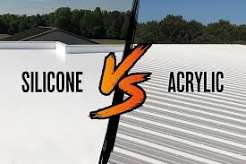
Flat roofs present a specific and persistent challenge for building owners and facilities managers. Unlike sloped roofs that shed water by design, flat roofs hold standing water, absorb thermal expansion cycles, and face long-term exposure to ultraviolet radiation without the same natural drainage advantage. When a coating fails on a flat roof, the consequences are not limited to a repair bill — they extend to interior damage, business disruption, and a compressed timeline for decisions that should have been made more carefully the first time.
Choosing between silicone and acrylic coatings is one of those decisions. Both are widely available, both are applied by experienced contractors, and both appear in specifications across commercial and industrial flat roofing projects. But their performance characteristics differ in ways that matter considerably when the roof is holding water after a rainstorm or contracting sharply through a winter temperature drop. Understanding those differences requires looking past marketing claims and examining how each material actually behaves once it is on the roof.
How Roofing Silicone and Acrylic Coatings Are Fundamentally Different
The distinction between silicone and acrylic starts not with application technique but with material chemistry. Silicone is a polymer with a silicon-oxygen backbone that gives it exceptional flexibility and resistance to both heat and water. Acrylic is a water-based polymer that forms a film as it dries. Both are classified as elastomeric coatings, meaning they can stretch and return to their original shape under stress, but the degree and durability of that elasticity differs significantly depending on the conditions the roof faces.
For anyone evaluating roofing silicone as a long-term solution for a flat roof, the primary advantage is its resistance to ponding water. Silicone does not absorb water and does not degrade when submerged for extended periods. This is not a minor feature for flat roofs — it is the defining performance characteristic that separates it from acrylic in high-moisture environments.
Acrylic coatings, by contrast, are formulated to perform well in conditions where water moves off the surface quickly. They are breathable, which makes them appropriate for certain substrates, but that same breathability creates vulnerability when water sits on the roof for more than a day or two. The coating begins to absorb moisture at the edges of ponded areas, softening the film and reducing its bonding strength over time.
The Role of Ponding Water in Long-Term Coating Failure
Ponding water is water that remains on a roof surface for more than 48 hours after a rain event. It is common on flat roofs that have minor drainage issues, low points from structural deflection, or blocked drains. On a well-maintained flat roof with adequate slope and clear drainage, ponding may not be a recurring issue. But in practice, most flat roofs experience some degree of standing water throughout their service life.
For acrylic coatings, repeated exposure to ponding water is one of the leading causes of premature failure. The coating does not catastrophically fail on first contact — it degrades gradually. Each ponding cycle introduces a small amount of water absorption into the coating film. Over months and years, this repeated exposure causes the film to become less flexible, more prone to cracking, and less adhesive to the substrate below. The roof may look intact from a distance while losing its protective properties beneath the surface.
Silicone does not respond this way. Its molecular structure resists water absorption, meaning that ponding events do not erode its performance in the same incremental way. A silicone-coated flat roof that experiences standing water regularly will generally outlast an acrylic-coated roof in the same condition, not because silicone is chemically inert under all circumstances, but because water exposure is specifically the condition it is engineered to endure.
UV Exposure and Thermal Movement Over Time
Flat roofs in most climates are exposed to direct sunlight for a significant portion of the year. UV radiation degrades organic polymers by breaking chemical bonds in the coating’s molecular chain. This process, known as photo-oxidation, causes coatings to become brittle, fade, and crack. The rate at which a coating degrades under UV exposure depends on the stability of its base chemistry.
Silicone has inherently strong resistance to UV degradation due to the stability of its silicon-oxygen bonds, which are less reactive to ultraviolet energy than carbon-based bonds. This means silicone coatings generally maintain their flexibility and adhesion longer when exposed to sustained sunlight without requiring additives or recoating cycles to compensate for UV-induced breakdown.
Acrylic coatings can be formulated with UV stabilizers, and high-quality acrylic products perform reasonably well under moderate sun exposure. However, in climates with intense solar radiation or in applications where the roof surface reaches high temperatures consistently, acrylic will typically show signs of chalking and surface erosion earlier in its service life than silicone. This is not a failure of the product — it is a function of the chemistry.
Thermal Movement and Its Impact on Adhesion
Flat roofs expand and contract with temperature changes. On a commercial roof in a climate with wide seasonal temperature swings, the membrane or substrate beneath the coating moves substantially over the course of a year. A coating that cannot accommodate that movement without cracking will develop micro-fractures that eventually allow water infiltration.
Both silicone and acrylic are designed with some degree of elasticity to handle thermal movement. However, as coatings age and are repeatedly stressed by thermal cycling, their elasticity diminishes. Acrylic coatings that have experienced UV degradation lose elasticity faster, meaning they crack sooner when the substrate shifts. Silicone retains its flexibility longer into its service life, making it more reliable in conditions where thermal movement is a consistent operational factor.
This distinction matters most in the years between five and fifteen of a coating’s service life. In early years, both materials may perform comparably. The real difference becomes visible in the middle years of the coating’s lifespan, when acrylic may require maintenance recoating while a silicone installation continues to perform without intervention.
Application Conditions and Substrate Compatibility
No coating performs well if it is applied incorrectly, and both silicone and acrylic have specific application requirements that influence their long-term outcome. Acrylic is water-based, which makes it sensitive to temperature and humidity during application. It cannot be applied when temperatures are near freezing or when rain is expected within a certain window after installation. Because it dries by evaporation, environmental conditions at the time of application directly affect film formation and adhesion.
Silicone coatings cure through a chemical reaction with atmospheric moisture, which means they are generally less sensitive to ambient temperature during application. They can cure at lower temperatures than acrylic, which broadens the application window in cooler climates. This also means fewer lost working days for contractors during transitional seasons, reducing delays on time-sensitive projects.
Substrate Compatibility and Existing Roof Conditions
The condition of the existing roof surface plays a significant role in determining which coating is appropriate. Silicone bonds well to most common roofing substrates — modified bitumen, TPO, existing silicone coatings, and metal — when properly primed. However, silicone has a well-documented characteristic: it does not bond well to surfaces that have been previously coated with acrylic. This limits options if a silicone recoat is planned over an acrylic-coated roof without full removal or encapsulation.
Acrylic coatings are generally more forgiving with substrate compatibility and can be applied over a wider range of existing conditions, including over certain types of aged acrylic coatings. This flexibility makes acrylic a practical choice in renovation scenarios where the existing coating cannot be fully removed without significant expense or disruption. According to industry guidance from organizations such as the Roof Coating Manufacturers Association, proper surface preparation remains the most critical factor in the long-term performance of any liquid-applied coating, regardless of chemistry.
Maintenance Requirements and Expected Service Life
The longevity of either coating depends on several factors: application quality, substrate preparation, ongoing maintenance, and the severity of the environmental conditions the roof faces. Generalizing exact service life figures is not useful because performance varies widely by climate, building use, and roof design. What is more useful is understanding which coating is more forgiving when maintenance is deferred and which degrades more predictably when conditions are not ideal.
Silicone coatings, because of their resistance to water and UV, tend to require less reactive maintenance. Their degradation curve is slower, which means that a roof not inspected for a period of time is less likely to have experienced critical failure. Acrylic coatings are more maintenance-dependent — surface recoating may be needed earlier in the coating’s life, particularly if ponding water or UV exposure has been significant. This does not make acrylic a poor choice, but it does mean the total cost of ownership should account for additional maintenance intervals that silicone may not require at the same frequency.
Cost Considerations Beyond the Initial Installation
Silicone coatings typically carry a higher material cost per unit than acrylic. For large commercial roof areas, this difference is meaningful in the initial project budget. However, the relevant comparison is not the upfront cost alone — it is the cumulative cost over the expected service life of the system, including maintenance labor, recoating, and the risk of unplanned repairs caused by coating failure. A silicone system that does not require recoating for a longer period may ultimately represent lower total expenditure than a lower-cost acrylic system that needs maintenance intervention more frequently.
This is the calculation that building owners and facilities managers should work through before selecting a coating, and it is the one most often overlooked when procurement decisions are made on material cost alone.
Making the Right Choice for a Flat Roof
The comparison between silicone and acrylic coatings on flat roofs does not produce a single universal answer. The better choice depends on the specific conditions the roof faces — primarily how much standing water it sees, how intense the sun exposure is, and what the existing substrate looks like. But the evidence from real-world performance across these variables points to a clear pattern.
For flat roofs with drainage challenges, significant UV exposure, or a history of ponding water, roofing silicone consistently demonstrates longer-lasting performance with less reactive maintenance. Its resistance to water absorption and UV degradation makes it the more reliable material in the conditions that flat roofs most commonly encounter. Acrylic remains a practical and cost-effective option in controlled conditions — where drainage is reliable, the existing substrate is compatible, and regular maintenance is part of the building’s operational routine.
The decision should be driven by an honest assessment of the roof’s conditions, not by initial material cost or contractor familiarity. A coating selected for the right reasons, applied correctly to a properly prepared surface, will always outperform one chosen for the wrong reasons — regardless of which material ends up on the roof.
