

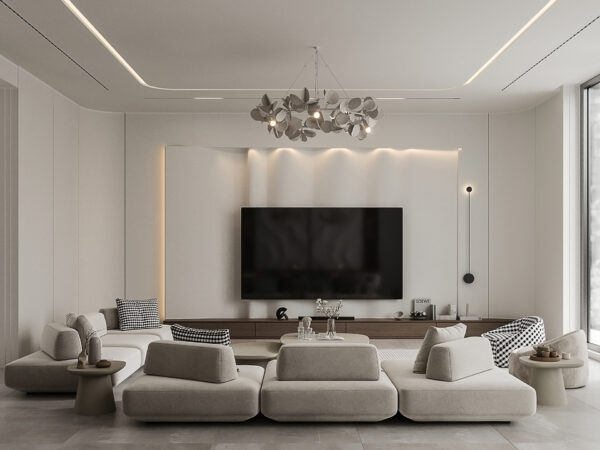
The wall where your television lives is one of the most looked-at surfaces in your home, yet it is consistently one of the least styled. Cables, a generic stand, an awkwardly sized unit — most TV walls are functional at best. Two choices, made well, can completely transform the space: a TV standthat doubles as a design statement, and lighting that frames the wall so the television feels intentional rather than dominant.
Why the TV Stand Deserves More Attention
A media unit does several things at once. It houses the television at the correct viewing height, conceals cables and media equipment, provides storage, and — if chosen correctly — anchors the entire room visually. The most important dimension to get right is width. The unit should be at least as wide as the television and ideally wider, extending beyond the screen on both sides to frame it. For large screens (65 inches and above), a size range of 180 to 215 cm is usually ideal.
Understanding Wood Finishes and Styles
| Finish | Atmosphere | Best Room Style |
| Natural wood | Warm, Scandinavian, organic | Japandi, Nordic, organic modern |
| Dark wood | Sophisticated, grounded | Contemporary, transitional, luxe |
| Black | Sharp, dramatic | Minimalist, industrial, modern |
| White ash / ashen black | Graphic, architectural | Urban modern, eclectic |
| Teakwood | Rich, heritage | Tropical modern, maximalist |
The Orbique TV Unit comes in natural, dark, and black colourways at 2,550 AED. The Julian series mirrors this flexibility with the same three finishes at 2,490 AED. Both options are priced based on data from homekode.com.
Display Shelving vs. Closed Storage
Open shelving — Units like the Lunova Display Shelf series create a gallery-style wall. They work beautifully when you have books, sculptural objects, and decorative vases to display. The trade-off is that clutter is immediately visible.
Closed storage with slatted doors — The Ziyah Wooden Slat Door TV Unit (from 2,750 AED) hides everything behind a textured facade that still reads as furniture rather than a box. Ideal for families who prefer a clean room without sacrificing storage.
Combined units — The Nolan TV Unit series balances open shelving sections with closed compartments, giving you the best of both approaches.
How Pendant Lighting Changes the TV Wall
A pendant light placed near the TV wall creates a secondary light zone that makes evening viewing more comfortable. Watching television in a completely dark room causes eye strain because the screen is the only light source. A warm, indirect light source nearby reduces contrast between the screen and the surrounding wall.
Beyond function, pendant lighting adds height and sculptural interest to what is typically a horizontal composition. A woven rattan pendant — like the Renix Rattan Black or Natural Ceiling Lamp (from 690 AED) — introduces organic texture that softens the hard rectangle of the screen. For more architectural rooms, the Curvyn Ceiling Lamp (from 695 AED) or the Serene Layered Pendant Lamp (from 660 AED) offer geometric forms that work well above a sleek wooden media unit.
Practical Tips for Pendant Placement
- Height: Pendants should hang at least 200 cm from the floor to avoid interrupting the sightline when seated.
- Position: Place the pendant to one side of the television rather than directly above it, to avoid glare on the screen.
- Warmth: Use bulbs in the 2700K–3000K range. Cool white light in a living room feels clinical.
- Layering: A pendant works best alongside floor lamps and shelf lighting — not as the sole source of artificial light.
Putting It Together: A Cohesive TV Wall
The most effective TV walls follow a simple logic: one primary piece (the media unit), one lighting element, and a limited number of objects on the shelves. Three objects are better than seven. Negative space — areas left deliberately empty — makes the objects that are present read more clearly.
A considered combination might look like this: the Nolan Natural Wooden TV Unit as the base, the Lunova Natural Wooden Display Shelf flanking it for books and decorative objects, and a Vorinx Rattan Natural Ceiling Lamp overhead to warm the wall with soft, diffused light.
Final Thoughts
Transforming a TV wall takes two decisions done well rather than a dozen done hastily. Choose a media unit with the right width, finish, and storage logic for how you actually live. Then add a pendant that complements the natural light in your room and the warmth of your materials. The result is a wall that your television happens to be on, rather than a wall that belongs to your television. What is the one thing about your current TV wall that you wish looked different?
