

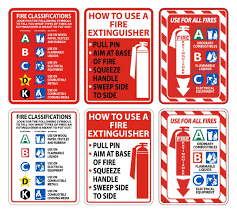
In facilities where fire safety equipment is regularly inspected, one of the most overlooked compliance failures involves something as straightforward as a label. Fire extinguisher labels are not decorative accessories — they are functional components that instruct users on how to operate equipment correctly under pressure. When a label fades, peels, or becomes illegible, the extinguisher does not automatically fail inspection, but the risk it creates in an actual emergency is real and measurable. Facility managers, safety officers, maintenance coordinators, and fleet operators all encounter this problem eventually, and many underestimate how complex sourcing a compliant replacement can be.
This guide covers what makes a fire extinguisher instruction label compliant, why replacement matters beyond cosmetic concerns, how to evaluate suppliers, and what to look for when integrating replacement labels into a broader maintenance program.
What a Fire Extinguisher Instruction Label Actually Does
A fire extinguisher instruction label serves a specific operational function: it communicates the steps a person must take to deploy the extinguisher correctly, quickly, and safely. This is not a summary of general fire safety — it is a step-by-step operational guide embedded directly on the unit. In a real emergency, a person approaching an extinguisher for the first time will rely on that label to determine how to remove the pin, aim the nozzle, and discharge the agent. If any part of that sequence is missing or unclear, the user may discharge incorrectly, aim at the wrong point, or fail to activate the unit at all.
For facilities sourcing replacements, a well-structured fire extinguisher instruction label must match the extinguisher type, agent class, and operational sequence of the specific unit it is applied to. Sourcing a generic label and applying it to a unit with a different agent class creates a different kind of risk — the instructions will be wrong for the actual equipment. This is why replacement labels are not interchangeable across all extinguisher types, and why supply decisions carry real safety weight.
The Difference Between Instruction Labels and Identification Labels
Extinguishers carry multiple labels, and it is important to understand that they serve different purposes. The identification label communicates unit specifications, agent class, manufacturer information, and service history. The instruction label is specifically designed to guide the user through the operation sequence at the moment of use. These are separate documents applied separately, and when a facility replaces one, it should not assume the other has been addressed. A compliant extinguisher requires both to be present, legible, and accurate. Mixing up their purpose when ordering replacements is a common and avoidable mistake.
Why Legibility Is a Compliance Issue, Not Just a Visual One
Inspection standards in many jurisdictions require that instructional labels be legible as a condition of compliance. An extinguisher that otherwise functions perfectly may be flagged during an annual inspection if the instruction label is faded beyond readability, damaged by chemical exposure, or partially obscured by wear. This is not a technicality — it reflects the practical understanding that a unit that cannot be operated correctly in an emergency is not a reliable safety asset. Legibility requirements exist because the label is considered an active part of the device’s functionality, not an afterthought.
Regulatory and Standards Context for Label Replacement
Fire extinguisher maintenance in commercial and industrial settings is governed by codes that set expectations for equipment condition, service intervals, and documentation. In the United States, NFPA 10, the Standard for Portable Fire Extinguishers, outlines requirements for inspection, maintenance, and recharging of portable extinguishers. Within that framework, the physical condition of user-facing labels is part of what determines whether a unit passes an inspection cycle. Facilities that operate across multiple sites, or that manage large extinguisher inventories, benefit from a consistent label replacement protocol that aligns with their inspection schedule.
How Standards Affect Supplier Selection
When purchasing replacement labels, the standards context matters because not every supplier produces labels that meet the material durability and content requirements expected during a formal inspection. Labels that use low-adhesion materials, fade-prone inks, or non-resistant coatings may pass initial installation but fail well before the next scheduled inspection. Suppliers who produce labels specifically for the fire equipment service industry understand these requirements and build durability into their materials accordingly. Selecting a supplier without confirming that their product is designed for compliance, rather than general labeling, introduces a predictable failure point into what should be a solved problem.
Multi-Site Facilities and Label Standardization
Organizations that manage fire safety equipment across many locations face a specific coordination challenge: inconsistent labeling. When different sites use different label sources, or when replacement labels have been applied piecemeal over time, the result is an inventory that lacks uniformity. This creates friction during audits, complicates inspection records, and introduces the possibility that some units are carrying non-compliant labels that have not yet been identified. Centralizing label sourcing through a single supplier that covers the full range of extinguisher types used across a portfolio is one of the more effective ways to prevent this pattern from developing.
Evaluating Suppliers for Replacement Fire Extinguisher Labels
The market for replacement labels includes general industrial label printers, specialty fire equipment suppliers, and wholesale distributors. Each category comes with trade-offs that matter depending on the scale of the operation and the frequency of replacement. General printers may offer lower per-unit pricing but may not maintain an inventory of labels matched to specific extinguisher types and agent classes. Specialty suppliers typically carry a broader catalog of type-specific labels and understand the compliance requirements that general printers do not prioritize.
Catalog Depth and Type-Specific Availability
A supplier’s catalog depth is one of the most practical indicators of their suitability for fire equipment service providers or facility managers with varied inventories. A useful supplier maintains labels matched to dry chemical, CO2, wet agent, and clean agent extinguishers, as well as labels specific to different mounting configurations and pressure types. When a supplier only stocks a narrow range, a buyer managing a diverse inventory will inevitably encounter stock gaps that force substitutions — and substitutions in this context carry compliance risk. Before committing to a supplier relationship, it is worth auditing your extinguisher inventory and confirming that the supplier’s catalog matches the full range of units you maintain.
Material Quality and Field Durability
Labels applied to fire extinguishers are exposed to a range of environmental conditions depending on where the units are stored. Warehouse environments may involve chemical vapor exposure, temperature swings, and humidity. Outdoor or semi-outdoor installations expose labels to UV radiation, moisture, and direct contact with dust or debris. Labels intended for fire extinguisher use should be produced from materials that resist these conditions without delaminating, fading, or losing adhesion before the next inspection cycle. Asking a supplier about their substrate materials, adhesive type, and expected service life under common environmental conditions is a reasonable and necessary part of supplier evaluation.
Order Fulfillment and Minimum Quantities
For service providers who replace labels as part of a routine maintenance workflow, order fulfillment consistency matters. A supplier who ships irregularly, maintains unreliable stock, or requires minimum order quantities that exceed a typical service cycle creates inventory management problems. Many service organizations find it practical to maintain a small working stock of common label types, replenished on a predictable schedule. A supplier whose ordering process supports this model — with reliable lead times and reasonable minimum quantities — is structurally easier to work with than one who offers competitive pricing but inconsistent availability.
Integrating Label Replacement Into a Maintenance Program
Label replacement is most effective when it is embedded in a broader maintenance protocol rather than treated as an ad hoc task triggered only when a label becomes visibly damaged. Facilities that inspect their extinguishers on a scheduled cycle can incorporate a label condition check as a formal step in that process, with replacement triggered by specific criteria such as fading below readable threshold, peeling at the edges, or damage from physical impact. This approach prevents labels from reaching a fully unreadable state before replacement is initiated, and it creates a documented record that labels have been checked and maintained alongside the unit itself.
Documentation and Inspection Records
When a label is replaced, the action should be logged in the unit’s maintenance record. This matters because inspection records serve as evidence of compliance during audits, insurance reviews, and post-incident investigations. A maintenance record that shows regular label checks and timely replacements demonstrates a proactive safety posture that is qualitatively different from one where label condition is never formally noted. The cost of maintaining this documentation is minimal — it requires adding a field to an existing inspection form and training technicians to record replacements consistently.
Conclusion
Replacing a fire extinguisher instruction label is a straightforward task when approached with the right preparation, but it carries more operational weight than its simplicity implies. The label is a functional component of the extinguisher, not a secondary accessory, and its condition directly affects whether the unit can be used correctly in an emergency. For facilities managing multiple units or multiple sites, the sourcing and standardization decisions made around labels have compounding effects on compliance consistency over time.
Selecting a supplier with catalog depth, material quality suited to field conditions, and reliable fulfillment eliminates a predictable source of inspection failures. Embedding label replacement into a scheduled maintenance workflow — rather than responding to visible damage alone — creates a more defensible compliance record and a safer operating environment. The investment in getting this right is modest, and the cost of getting it wrong, whether during an inspection or an actual emergency, is not.
