

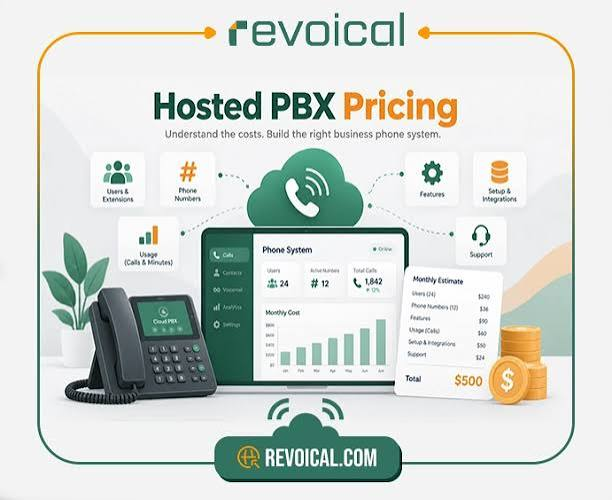
When a business moves its phone infrastructure to a virtual PBX system, the expectation is usually straightforward: lower overhead, fewer physical components to maintain, and a monthly bill that replaces the unpredictability of legacy telecom contracts. That expectation is reasonable. What often goes unexamined, however, is the gap between what a plan advertises and what it actually costs once a business is fully operational on the system.
This gap is not always the result of deceptive practices. In many cases, it reflects how virtual PBX services are structured — with a base rate that covers core functionality and a surrounding layer of add-ons, usage limits, and per-seat conditions that only surface after the initial contract is signed. For businesses managing communication across multiple locations, remote staff, or customer-facing operations, these secondary costs can meaningfully affect the total expenditure over a contract term.
Understanding how virtual PBX pricing actually works — not how it is presented in a sales conversation — is an essential part of making a sound infrastructure decision.
How Virtual PBX Pricing Is Structured and Where the Gaps Appear
Most virtual PBX services price their plans around a per-user or per-seat model, with different tiers offering progressively more features. On the surface, this looks clean and scalable. In practice, the advertised per-seat rate is often the minimum a business will pay, not the average. When evaluating virtual pbx pricing, it is worth examining not just the headline number but the full condition set attached to it — because the conditions are where the real cost lives.
A thorough breakdown of virtual pbx pricing structures, including what different service tiers typically include and exclude, can help businesses avoid underestimating their actual monthly outlay. Resources like this one on virtual pbx pricing provide a useful reference point for understanding what a genuinely transparent plan looks like compared to one that buries conditions in footnotes.
The Per-Seat Model and What It Does Not Include
Per-seat pricing creates a predictable baseline, but it rarely accounts for the full scope of how a business actually uses its phone system. Many providers limit features like call recording, voicemail transcription, or advanced call routing to higher tiers. If a business signs at a lower tier and then discovers these features are necessary for daily operations, it either upgrades all seats to the next tier or pays per-feature charges on top of the existing rate.
This is a common pattern: a business negotiates a competitive per-seat rate, then spends the following months adding features that bring the effective cost per user significantly above what was originally quoted. The original rate was accurate — it just did not reflect the full operational requirement.
Annual Commitments and Mid-Term Adjustments
Many virtual PBX providers offer a lower monthly rate in exchange for an annual or multi-year commitment. This trade-off can make sense for stable businesses, but it introduces risk for organizations that are growing, restructuring, or uncertain about their headcount. If a business needs to add users mid-contract, those additional seats are often priced at a different — sometimes higher — rate than the original agreement. If the business needs to reduce seats, many contracts do not allow downward adjustments mid-term without a penalty.
The result is a pricing structure that rewards stability but penalizes change. For businesses in a growth phase or those managing seasonal staffing, this asymmetry can create real budget pressure that was not anticipated at the time of signing.
Usage Limits That Are Easy to Miss
A significant number of virtual PBX plans advertise unlimited calling as a feature, but this designation carries conditions that are rarely explained upfront. Unlimited calling in most contexts means unlimited calls between users on the same account, or unlimited inbound calls, or unlimited calls within a defined geographic region. International calls, toll-free number usage, and calls to certain carriers or regions are almost always billed separately.
For businesses that regularly communicate with international clients, vendors, or remote staff in other countries, these per-minute charges can accumulate quickly. The unlimited label creates an assumption that is easy to make and difficult to reverse once the billing cycle has run.
Toll-Free Number Costs
Toll-free numbers are a common business requirement, particularly for customer-facing operations. However, most virtual PBX plans treat toll-free numbers as an add-on rather than a standard inclusion. There is typically a monthly fee for each toll-free number, and incoming calls to those numbers are often billed at a per-minute rate that is separate from whatever calling allowance the base plan provides.
A business with a single customer service line may not find this significant. A business running multiple departments, each with its own toll-free number, or a business with high inbound call volume, can see toll-free costs become a meaningful line item that was not factored into the initial budget comparison.
Storage and Recording Limitations
Call recording has become a baseline expectation for many industries, particularly those operating under compliance requirements. According to guidance published by the Federal Trade Commission, certain communication records carry legal and operational obligations depending on the nature of the business and the type of data being handled. Despite this, virtual PBX providers frequently restrict call recording to higher-tier plans, and even where it is included, storage is often capped at a specific duration — thirty days being common.
For businesses that need to retain recordings for compliance, dispute resolution, or quality assurance, the cost of extended storage or unlimited recording access is an additional charge. This is worth clarifying before signing, particularly in regulated industries where record retention is not optional.
Onboarding, Support, and Transition Costs
The operational cost of switching to a new virtual PBX system extends beyond the monthly subscription. Number porting — the process of transferring existing phone numbers from a previous provider — is often marketed as a straightforward process, but it carries both a timeline and a cost. Porting multiple numbers across multiple locations takes time, and some providers charge per number ported. During the transition period, call routing may need to be managed across two systems simultaneously, which adds administrative complexity.
Technical support tiers are another area where costs diverge from initial expectations. Many providers offer basic support through self-service documentation and ticket systems, with premium support — meaning faster response times, dedicated account access, or phone-based assistance — available only at higher plan tiers or as a paid add-on. For businesses where communication reliability is operationally critical, the value of accessible support is real, but it rarely comes included in entry-level pricing.
Integration Costs With Existing Systems
Virtual PBX systems are frequently marketed with integration capabilities — CRM connections, helpdesk platforms, scheduling tools, and similar business applications. These integrations are a legitimate operational benefit. What is often less clear is that deep integrations, or integrations with specific platforms, may require a higher plan tier, a separate API access charge, or a third-party middleware service to function properly.
A business comparing virtual pbx pricing across providers should ask specifically which integrations are included at which plan levels, and what the cost or technical requirement is for connecting the system to tools already in use. A plan that appears less expensive on a per-seat basis may cost more in total once integration requirements are factored in.
What a Transparent Pricing Structure Actually Looks Like
Not all virtual PBX providers obscure their costs. Some publish detailed pricing pages that clearly separate base plan costs from optional add-ons, specify what is and is not included in unlimited calling terms, and outline porting timelines and fees before a contract is signed. These are meaningful signals when evaluating providers.
A transparent virtual pbx pricing structure will make it possible to calculate a realistic monthly cost before speaking to a sales representative. It will distinguish between inbound and outbound calling costs, clarify storage and recording policies, and state explicitly which features are tier-dependent. Where these details are absent or difficult to locate, that absence is itself informative.
Businesses that treat virtual pbx pricing as a comparison exercise — evaluating total operational cost rather than advertised base rate — are significantly better positioned to avoid the mid-contract surprises that affect many organizations that moved quickly through the vendor selection process.
Concluding Thoughts
Virtual PBX systems offer real advantages for businesses managing distributed communication needs. The technology is mature, the infrastructure is reliable when properly selected, and the flexibility compared to legacy systems is genuinely useful. None of that changes the fact that the pricing models attached to these systems are often more complex than they appear at first review.
The businesses that end up paying more than they expected are rarely those that were misled outright. More often, they are businesses that evaluated cost at the headline level, did not ask specific questions during the sales process, and discovered the full cost structure only after they were operationally committed to the platform.
Taking the time to examine per-seat conditions, calling limitations, storage policies, support tiers, and integration requirements before signing does not require legal expertise or deep technical knowledge. It requires asking direct questions and expecting direct answers — and treating the absence of clear answers as a signal worth paying attention to.
